
About Nanoose Bay

Nanoose Bay’s Native Trees and Plants
Nanoose Bay sits within the Coastal Douglas-fir zone — the smallest of British Columbia’s sixteen major ecosystem types, and one of the most endangered in the entire country. Most visitors walking its trails have no idea that the native plants and trees around them belong to something genuinely rare.
A Rare Ecosystem
The Coastal Douglas-fir zone is found only in a narrow band along southeastern Vancouver Island, the southern Gulf Islands, and a sliver of the mainland — a mild, almost Mediterranean climate created by the rain-shadow effect of the Vancouver Island and Olympic mountains. It’s ranked among the top four most endangered ecosystems in Canada, alongside places like Manitoba’s tallgrass prairie. Two species define it more than any others: Douglas-fir and arbutus, both genuinely central to what Nanoose Bay looks and feels like.
The Big Trees
Douglas-fir is the workhorse conifer throughout the community — the tree behind the historic sawmill covered in The Lost Industry of Nanoose Bay, and still the dominant canopy species at Moorecroft and along most trails today. Western redcedar and grand fir fill in around it in moister spots.
Arbutus — also known as Pacific madrone — is the tree most people actually stop to look at: broadleaf, evergreen, with smooth, reddish bark that peels away in papery curls, twisting into shapes no conifer ever manages. It’s found nowhere else in Canada outside this small coastal pocket, and it shows up constantly across this site’s descriptions of local trails, from Beachcomber to Notch Hill. Its other name has Spanish roots: explorers on this coast called it madroño, after the strawberry tree they knew from home, and the word survives locally in Madrona Point on Northwest Bay.

Garry oak is the third defining species — gnarled, deeply grooved, and even rarer than arbutus. Garry oak ecosystems are found nowhere else in Canada, and support the highest plant diversity of any terrestrial ecosystem complex on the coast. South Winchelsea Island, just off the mouth of the bay, protects a particularly good example.
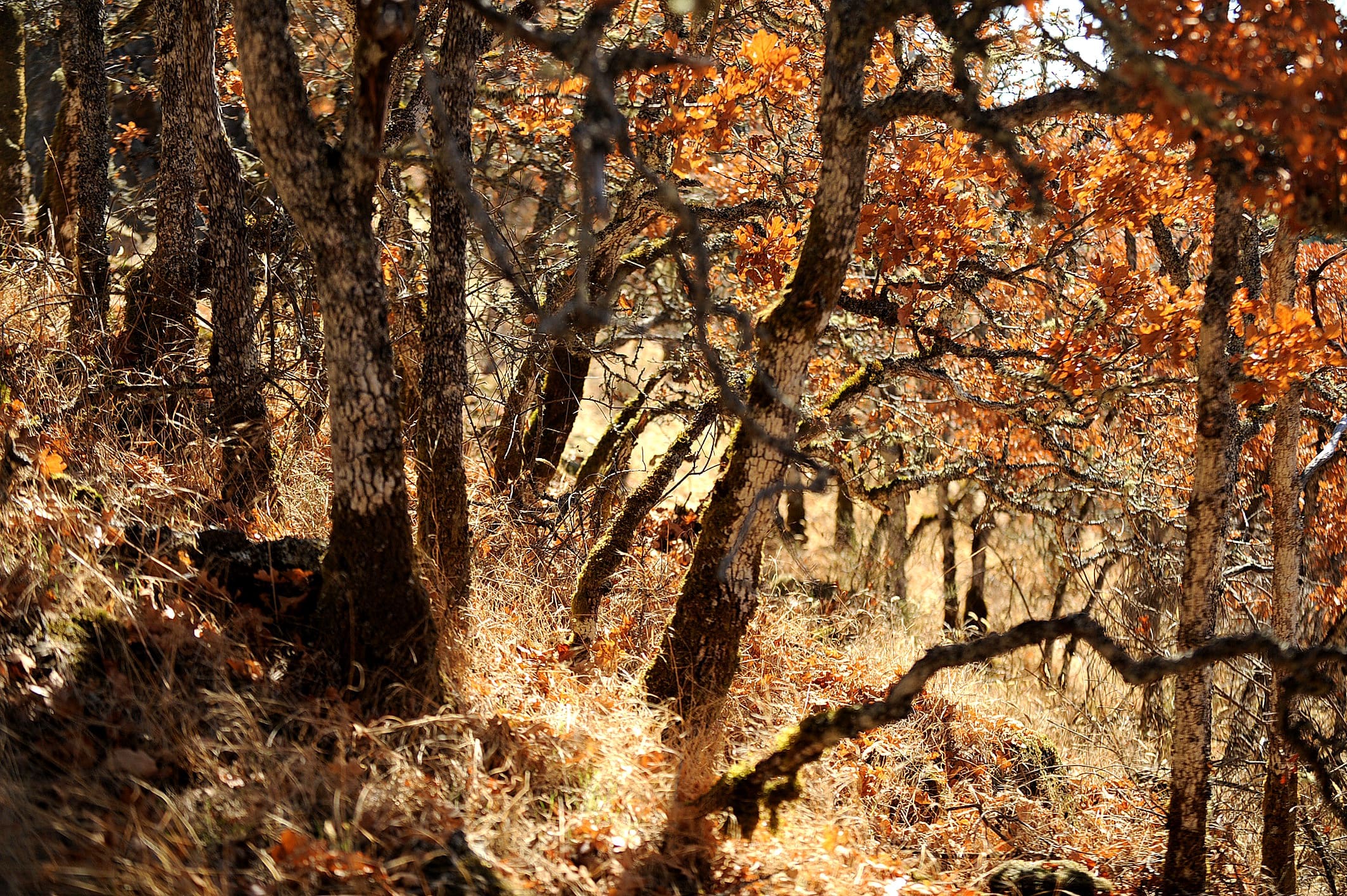
Spring in the Meadows
Where Garry oaks grow in open meadow rather than closed forest, spring brings a genuinely striking wildflower display: camas (both common and great camas), chocolate lily, shooting star, and satin-flower, among others. These meadows aren’t wild in the sense of untouched — they’re the product of thousands of years of active management. Coast Salish women traditionally tended camas meadows as a staple food source, harvesting the bulbs while replanting others and using controlled burning to keep the beds healthy — a sophisticated form of land stewardship that shaped these ecosystems long before European contact. For more on the people who did this work, see Snaw-naw-as Today.
Native Plants of the Understory
Beneath the canopy, a fairly consistent cast of shrubs shows up throughout Nanoose Bay’s forests: salal, Oregon grape, oceanspray, snowberry, baldhip rose, and trailing blackberry. In wetter, shadier pockets — like the ground around Skipsey Lake at Moorecroft — ferns take over instead: lady fern, spiny wood fern, and the strikingly tall giant horsetail, along with a thick carpet of moss that gives these damper trails their distinctive look and feel.
Where to See Native Plants in Nanoose Bay
You don’t need to go far. Moorecroft Regional Park is the easiest place to walk under a mature Douglas-fir canopy, and the damp ground around Skipsey Lake shows off the ferns and mosses. Arbutus lines the rocky shoreline at Beachcomber and the slopes of Notch Hill, where the trees lean out over the water in search of light. For Garry oak, the best-preserved example nearby is South Winchelsea Island, visible from shore. Spring is the time for wildflowers: by April, camas and its companions are in bloom in the open meadows.
Native Plants in the Garden
Many of Nanoose Bay’s native plants make good garden plants, because they are already suited to wet winters and dry summers. Salal, Oregon grape and oceanspray need little or no watering once established, and they feed pollinators and birds through the year. Fall is the best time to plant, so roots can settle in over the rainy season. Buy from a nursery that grows native plants from seed or cuttings; digging plants from parks or the wild damages the very places this page describes.
The Uninvited
Not everything green belongs here. Scotch broom, English ivy and Himalayan blackberry spread quickly through disturbed ground and crowd out native plants, especially in the open meadows where camas and other wildflowers grow. Pulling broom before it sets seed, and keeping ivy off tree trunks, are two of the most useful things a landowner can do.
Worth Protecting
Given how rare this ecosystem is nationally, the Garry oak meadows, arbutus groves, and old Douglas-fir stands scattered through Nanoose Bay’s parks — and the forest around Shooting Star Falls on the inland side of the highway aren’t just scenery — they’re a genuinely significant piece of what’s left of a vanishing ecosystem type in Canada, worth the same care and attention this site tries to give the community’s wildlife and history. The Coastal Douglas-fir zone covers only about 0.3 per cent of British Columbia, and roughly 80 per cent of it is privately owned. That means much of its future rests with the people who live in it.
Last updated:
← Back to All the Stories | See also: Nanoose Bay’s Land Wildlife | View on the map →